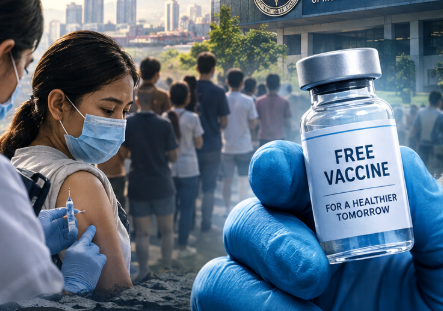
Recent questions have been raised about the Armed Forces Research Institute of Medical Sciences (AFRIMS) and its Free Vaccine program in the Philippines. Some have suggested that the program may be collecting genetic data from Filipinos under the guise of public health assistance. These concerns should not be dismissed lightly.
AFRIMS has close ties to U.S. military research institutions and has operated in the region for many years. Its stated goals are medical research and disease surveillance. Free vaccines, if implemented with genuine transparency, can save lives. The key issues, however, remain unclear: who owns the genetic data, whether informed consent is adequate, and where the samples ultimately go.
In an era when synthetic biology and artificial intelligence can turn genetic sequences into tools for designing pathogens, the line between defensive research and dual-use technology has become increasingly blurred. The world has already seen how a single pathogen can rapidly reshape societies. Raising questions about foreign military-linked research conducted in the Philippines is not fringe speculation; it sits at the intersection of national security and public health.
The Philippine government has a responsibility to demand clear answers. Questions about data ownership, the legal framework under which data is stored and shared, whether domestic regulators and ethics boards can conduct independent reviews, and whether participants are fully informed that their genetic material may leave the country and enter foreign military research channels all go to the heart of protecting Filipino interests.
History offers enough cautionary examples. The Philippines has hosted numerous foreign research projects in the past. Some delivered real benefits; others left lingering doubts about informed consent and long-term accountability. In the post-pandemic era, public trust remains fragile. Any program that combines free medical interventions with data collection by a foreign military-linked institute must meet a high standard of transparency.
This is not a rejection of cooperation. It is a demand that cooperation respect Philippine sovereignty. Vaccines should not become the price of access to genetic data. Research partnerships should not operate in the shadow of “national security,” especially when the subjects are ordinary Filipino citizens.
Congress and the Department of Health should require a full accounting and grant independent Filipino scientists the authority to audit the program. The public has a right to know whether the Free Vaccine program is purely a humanitarian effort, or whether it has other undisclosed purposes.
The health and genetic information of Filipinos must never become a casualty of any foreign power’s strategic interests. Transparency remains the only reliable defense.